

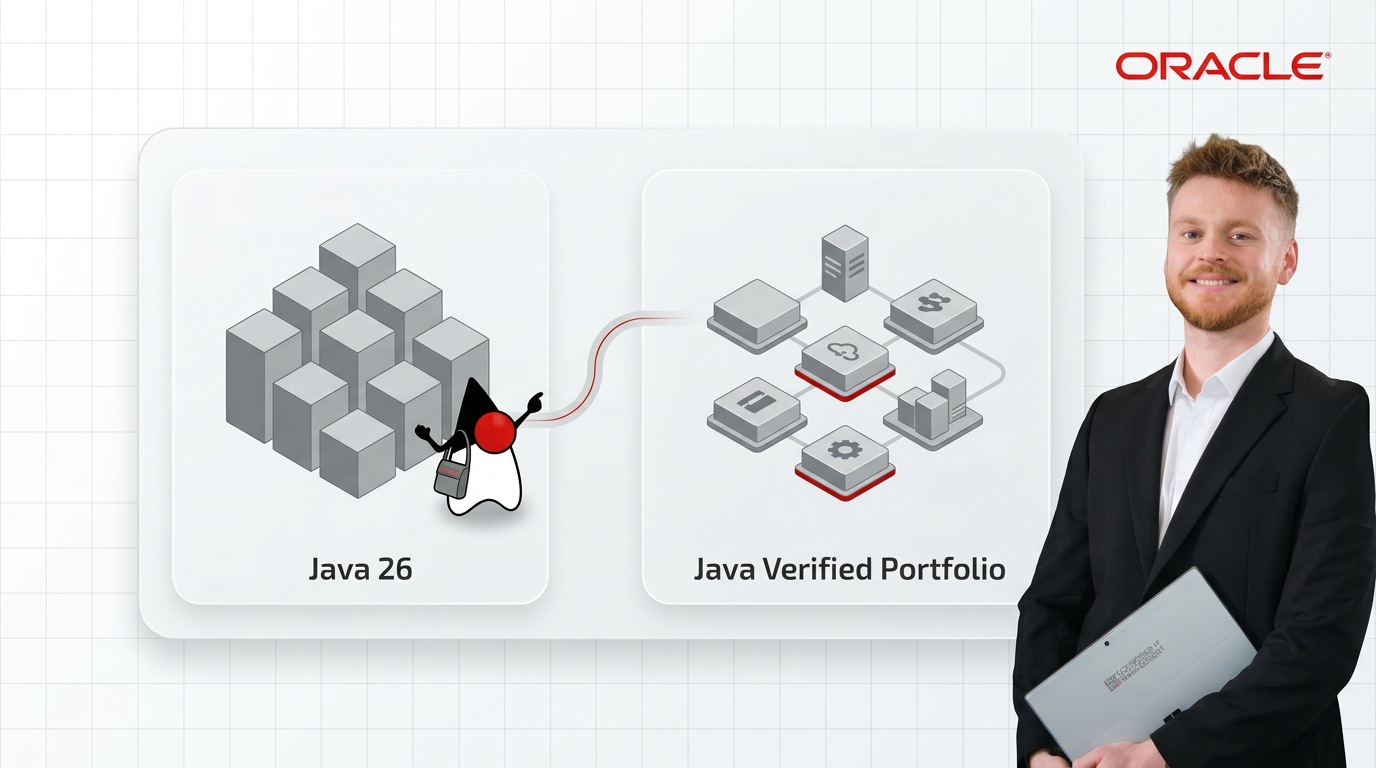
Build Java applications faster with stronger security and modern AI foundations: On March 17, 2026, Oracle released Java 26 and introduced the Java Verified Portfolio. This improves the Java platform and how Oracle supports the wider Java ecosystem used in enterprise environments.
Summary
- Java 26 becomes generally available with 10 JDK Enhancement Proposals (JEPs)
- New features strengthen AI integration, cryptography, performance, and language consistency
- Java Verified Portfolio (JVP) launches as a curated, Oracle-supported Java ecosystem, included free of charge with some licenses
- Commercial support for JavaFX, Helidon, Java Platform Extension for Visual Studio Code is reintroduced via JVP
- Organizations should review upgrade paths and Java licensing coverage
Java 26
What is Java 26?
Java 26 (Oracle JDK 26) is the latest regular release of the Java platform. Oracle publishes new Java versions every six months, in March and September. Java 26 follows Java 25, which is the current Long-Term Support (LTS) version.
Java 26 is not an LTS release. Instead, it introduces new capabilities earlier, allowing organizations and developers to test and adopt improvements before they later appear in a future LTS version.
What does Java 26 improve?
Java 26 introduces 10 JDK Enhancement Proposals (JEPs), which is what Oracle calls their innovations in Java. These are officially defined improvements to the Java language and runtime.

Java 26:
- Improves application startup time and overall performance
- Makes it easier to write and maintain complex, parallel workloads
- Strengthens cryptography and security handling
- Improved readiness for cloud-based and AI-driven applications
- Removes outdated components that are no longer relevant
Java 26 is mainly relevant for organizations that actively modernize Java applications or want early access to upcoming platform improvements.
Java Verified Portfolio

What is the Java Verified Portfolio?
The Java Verified Portfolio (JVP) is a new Oracle offering that bundles important Java-related tools, frameworks, libraries, and services that are not part of the Java Development Kit (JDK) itself.
Oracle created the Java Verified Portfolio to officially support important Java-related tools that companies already use, but that were previously outside Oracle’s Java support.
Many enterprise Java applications depend on components that sit around Java, not inside it. Examples include:
- User interface tools
- Microservices frameworks
- Developer tooling
These components often were open source, maintained separately and used in production without clear vendor support.
Historically, these components often had:
- Separate release cycles
- Separate support models
- Different documentation and lifecycle rules
JVP is Oracle’s answer to this fragmentation.
What problem does JVP solve?
JVP addresses three common enterprise concerns:
- Support clarity: Organizations want to know which components are officially supported by Oracle and under what conditions.
- Lifecycle alignment: Enterprises need predictable timelines for updates, fixes, and compatibility with Java versions.
- Software supply chain risk: Using many third-party components increases operational and security risk if ownership and support are unclear.
The Java Verified Portfolio creates a trusted, Oracle-governed layer around commonly used Java components.
What is included in JVP?
At launch, the Java Verified Portfolio includes, among others:
- JavaFX: JavaFX is used to build graphical user interfaces – for example desktop applications, dashboards, or visual tools. Oracle now provides official commercial support for JavaFX again – via JVP – which was missing.
- Helidon: Helidon is a framework used to build backend services, such as APIs and microservices. These services often run critical business processes and customer-facing systems. Oracle now includes Helidon under its supported Java ecosystem, aligns its releases with Java versions, and plans to bring it closer to OpenJDK governance. Oracle has stated that Helidon’s release cadence will be aligned with Java releases.
- Oracle Java Platform Extension for Visual Studio Code: This development extension helps programmers write, test, and manage Java code. Oracle now also treats this tooling as part of its verified and supported Java ecosystem.
How is JVP licensed?
JVP is not a standalone subscription. Key points:
- Included at no additional cost for customers with a Java SE Universal Subscription
- Included for Oracle Cloud Infrastructure (OCI) customers running Java workloads on OCI
- Some JVP components remain available for free use in specific scenarios, but commercial support is tied to Oracle subscriptions
JVP therefore acts as an extension of Oracle’s Java support universe, not a separate product.
Licensing overview: Java 26 and Java Verified Portfolio
The table below shows how Java licensing options compare and where the Java Verified Portfolio fits.
| Topic | Oracle No-Fee Terms and Conditions (NFTC) | Java SE Universal Subscription |
| Cost | Free | Paid subscription |
| Production use | Allowed | Allowed |
| Updates | Limited once a newer Java version is released | Continuous updates |
| Security fixes | Limited | Included |
| Oracle support | Not included | Included |
| Java Verified Portfolio | Not included | Included |
| Typical use case | Development, testing, limited production | Enterprise production, regulated environments |
Frequently asked questions (FAQ)
Do I need a new license to use Java 26?
No. Java 26 follows the same licensing rules as other recent Java versions. The licensing model depends on whether you use NFTC or a Java SE Universal Subscription.
Is the Java Verified Portfolio required to run Java?
No. JVP is optional. It becomes relevant if your organization relies on components such as JavaFX or Helidon and requires Oracle-backed support and clear lifecycle management.
Does JVP replace third-party tools?
No. JVP does not replace other frameworks. It provides a supported option for selected components within the Oracle ecosystem.
Is JVP only relevant for cloud environments?
No. JVP applies to on-premises, hybrid, and cloud-based Java deployments, including regulated and security-sensitive environments.
Next steps
- Review which Java versions are currently used across development, test, and production
- Decide whether Java 26 is relevant now or mainly as a preview for future LTS planning
- Identify dependencies on JavaFX, Helidon, or similar components
- Review whether a Java SE Universal Subscription is required to cover support needs
- Align Java roadmap decisions with security, compliance, and lifecycle requirements
Ready to review your Java roadmap?

Our Oracle licensing experts help organizations assess Java versions, licensing models, and support strategies with ease. Make sure you use the best Oracle strategy for your business case by getting in touch with our experts today.