
Hardware has become more expensive, and key components are harder to source.
For many organizations, adding more servers or memory is no longer a realistic default option.
VMware Cloud Foundation (VCF) 9.0 is positioned as a response to this reality. Instead of scaling by buying more hardware, it focuses on using existing infrastructure more efficiently and avoiding unnecessary refresh cycles. This article explores how to save costs with VCF 9.0.
Why saving on hardware costs matters now
What was once seen as a temporary supply chain disruption has become a long‑term structural issue.
Enterprises are now facing several persistent challenges:
- DDR5 server memory prices more than doubled during 2025 as supply tightened
- Major memory suppliers reported capacity sold out through 2026, leaving little visibility for enterprise buyers
- Around 95 percent of global DRAM supply is controlled by three vendors
- Manufacturers are shifting production toward high‑bandwidth memory (HBM) for AI workloads, reducing output of standard server DRAM
In practice, this means:
- New servers cost.
- Large memory configurations are harder to justify.
- Refresh projects are delayed or downsized.
Under these conditions, using existing hardware more efficiently becomes a primary cost‑saving lever.
How VMware Cloud Foundation (VCF) 9.0 helps reduce hardware costs
1) Decrease server purchase costs by right‑sizing memory
Memory is now one of the most expensive components in modern servers. Broadcom notes that in many current server configurations, memory accounts for more than 50 percent of the total server cost.
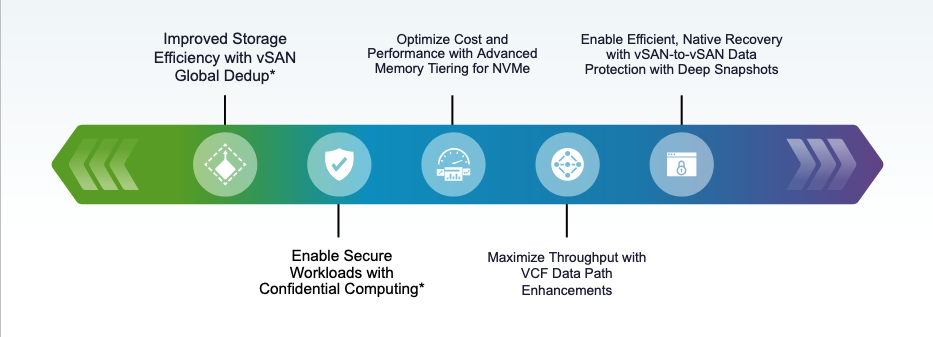
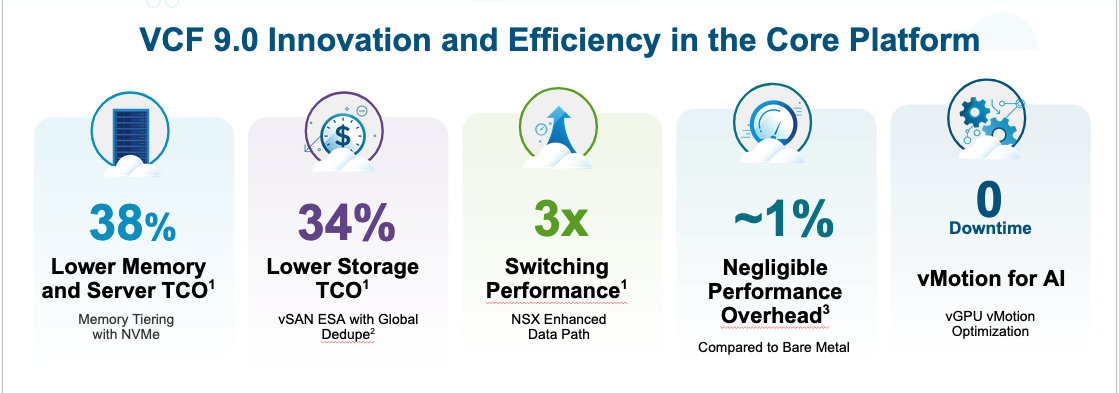
VMware Cloud Foundation (VCF) 9.0 addresses this through Non‑Volatile Memory Express (NVMe)‑based memory tiering.
Non‑Volatile Memory Express (NVMe) lets fast solid‑state drives (SSDs) communicate directly with the processor (CPU). This makes data access much faster than older storage technologies such as Serial ATA (SATA) or Serial Attached SCSI (SAS).
Memory tiering uses this fast storage as an additional memory layer, so not everything has to stay in expensive main memory.
Save costs through efficiency
- Smaller Dynamic Random‑Access Memory (DRAM) configurations per host
Dynamic Random‑Access Memory (DRAM) is the main working memory of a server. With memory tiering, servers no longer need to be sized for the worst‑case memory scenario. Less frequently used memory pages are automatically moved to NVMe storage. This allows for deliberate and safe DRAM downsizing. - Lower server purchase prices
Fewer Dual In‑Line Memory Modules (DIMMs) are required. DIMMs are circuit boards that contain DRAM chips and make up most of a server’s memory cost. Reducing the number of DIMMs has an immediate and measurable impact on server pricing. - Less risk‑driven over‑provisioning
Memory sizing is based on actual workload behavior instead of conservative safety margins. This avoids buying memory that remains unused most of the time.
Result: lower upfront server costs without reducing performance for supported workloads.
2) Delay new hardware purchases by increasing workload density
Another major hardware cost factor is how many applications and systems can run on each physical server.
VMware Cloud Foundation (VCF) 9.0 improves processor scheduling, memory handling, and Non‑Uniform Memory Access (NUMA) awareness.
Non‑Uniform Memory Access (NUMA) is how modern servers organize memory close to specific processors. Better NUMA awareness reduces delays when applications access memory.
Broadcom‑referenced benchmarks show up to 1.5x higher virtual machine density, depending on workload type.
Save money by using less resources
- More virtual machines per physical server
A virtual machine is a software‑based computer running on a physical server. Higher density means more virtual machines can run on the same hardware without performance problems. - Better balance between CPU and memory usage
Central Processing Units (CPUs) often remain underused because memory runs out first. VCF improves this balance so available CPU capacity can actually be used. - Fewer servers for the same environment
Growth can be absorbed through optimization rather than by buying additional servers. That directly reduces capital expenditure (capex).
Result: capital expenditure (CAPEX) is reduced by delaying or avoiding new server purchases.
3) Extend the usable life of existing servers
A common concern is whether modern platforms require immediate hardware replacement.
VMware Cloud Foundation (VCF) 9.0 does not automatically require new servers. Broadcom confirms that most servers certified for VMware vSphere and VMware vSAN 8.x remain supported.
Lower server costs
- Existing hardware remains productive longer
Servers that would otherwise be scheduled for replacement can continue running modern workloads under VCF 9.0. - Targeted upgrades instead of full replacements
In many cases, adding certified Non‑Volatile Memory Express (NVMe) drives is sufficient to unlock newer platform features instead of replacing entire servers. - Hardware refresh shifts from mandatory to planned
Server replacement becomes a business decision based on budget and strategy, instead of a forced requirement due to software limitations.
Result: longer hardware lifetimes and lower annual infrastructure spend.
4) Reduce infrastructure hardware through consolidation
VMware Cloud Foundation (VCF) 9.0 also reduces costs by consolidating multiple infrastructure components into the platform itself.
Instead of relying on separate physical devices for different functions, many of these capabilities run directly in software.
Decreased hardware costs
- Fewer dedicated hardware appliances
Network services, security functions, and load balancing can often be virtualized. This reduces or eliminates separate physical devices. - Lower storage footprint for the same data
Compression and deduplication reduce how much physical storage is needed to store the same amount of data. - Simpler architectures with fewer components
Fewer physical devices mean lower purchase costs, fewer support contracts, and less effort to maintain and replace equipment.
Result: reduced hardware complexity and ongoing operational expenses.
The Broadcom partner landscape has changed significantly
Following Broadcom’s integration of VMware, the partner ecosystem has been strongly consolidated.
On April 2, 2026, Broadcom:
- …offboarded more than 90 percent (%) of former partners
- …shifted to a small, highly specialized partner model
- Partners need certified teams of experts, with professionals specialized in licensing, planning, and implementation

SCHNEIDER IT MANAGEMENT’s role in the new Broadcom ecosystem
SCHNEIDER IT MANAGEMENT is one of only three (3) registered Broadcom partners in Luxembourg following the April 2, 2026 partner consolidation, and supports customers across Europe.
Our dedicated Broadcom and VMware specialists cover the entire lifecycle of customer investments, including:
- Platform strategy and architecture
- Licensing and contract structuring
- Vendor negotiations
- Implementation and migration
- Ongoing optimization and cost management
Our focus is to help customers maximize long‑term value from VMware Cloud Foundation (VCF), especially when hardware availability and pricing make efficiency critical.

Summary
The hardware market has changed for the long term. Memory prices have risen sharply, supply remains constrained, and over‑provisioning is no longer a sustainable approach.
VMware Cloud Foundation (VCF) 9.0 reduces hardware costs by:
- Reducing the amount of expensive server memory required
- Increasing workload density per server
- Extending the usable life of existing hardware
- Eliminating the need for separate infrastructure appliances
In a highly consolidated Broadcom partner landscape, achieving these benefits requires both technical insight and licensing expertise.
Ready to evaluate if VCF 9.0 will help you save costs?

As leading Broadcom partner, SCHNEIDER IT MANAGEMENT supports organizations in designing, licensing, and operating VMware Cloud Foundation environments with a clear focus on cost control, performance, and long‑term value.
Contact our Broadcom expert team today to save on hardware costs.