
Update 2026-07-01: This article updates our existing post “GitHub Copilot moves to usage-based billing” (last updated June 12, 2026). The new and changed information is highlighted in red below.
Turn variable GitHub spend into a predictable annual budget with built-in savings. Effective June 2026, Microsoft introduced two GitHub Pre-Purchase Plans, alongside GitHub Copilot’s move to usage-based billing on June 1, 2026.

Summary
- GitHub AI Credits replaced Premium Requests for GitHub Copilot on June 1, 2026, so most usage is now metered by tokens rather than by a flat request count.
- In June 2026, Microsoft added two GitHub Pre-Purchase Plans: a portfolio-wide GitHub Pre-Purchase Plan and a dedicated GitHub AI Credits Pre-Purchase Plan.
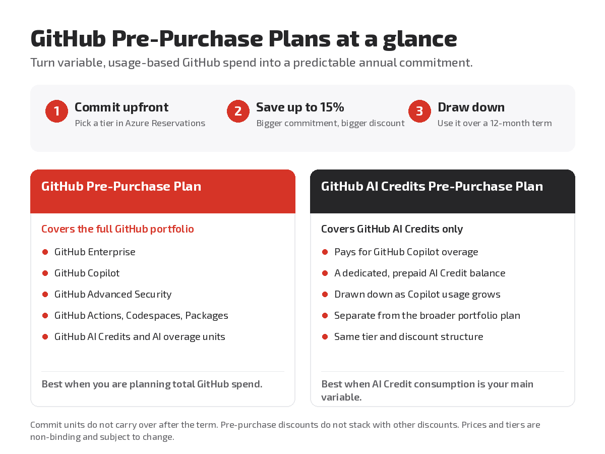
- Both plans let you commit an amount upfront through Azure Reservations and draw it down over a 12-month term, with built-in savings of up to 15 percent.
- The portfolio plan covers GitHub Enterprise, GitHub Copilot, GitHub Advanced Security, Actions, Codespaces, and AI Credits; the AI Credits plan covers GitHub AI Credits only, the budget you use for GitHub Copilot overage.
- Base subscription prices are unchanged, and each GitHub Copilot plan still includes a monthly AI Credit allowance.
- Pre-purchased commit units do not carry over after the term, and the discount does not stack with other discounts you may already hold.
What is new
Microsoft has introduced two GitHub Pre-Purchase Plans for commercial customers, both available now through Azure Reservations. They give finance and engineering teams a way to commit to an amount of GitHub spend upfront, use it across eligible services over a 12-month term, and receive a built-in discount that grows with the size of the commitment.
The plans do not replace how you buy GitHub today. They are an optional planning tool for organizations that have a reasonable view of expected usage and want budget certainty plus savings.
What is a GitHub Pre-Purchase Plan?
A GitHub Pre-Purchase Plan is a commitment-based purchase made through Azure Reservations. You buy commit units (CUs) at a discounted tier in your purchasing currency. Those units then pay down qualifying GitHub usage at its retail cost in US dollars (USD): if GitHub generates 100 US dollars of eligible usage, 100 GitHub commit units are consumed.
Each plan runs for a one-year term and, by default, renews at the end of the term. Larger commitments unlock higher discount tiers, up to 15 percent. If your usage exceeds the prepaid balance, you can buy another plan or continue on pay-as-you-go billing where available. Unused commit units do not carry over once the term ends.
The two plans
- GitHub Pre-Purchase Plan (portfolio): covers usage across the GitHub services umbrella, including GitHub Enterprise, GitHub Copilot, GitHub Advanced Security, GitHub Actions, Codespaces, Packages, Large File Storage, and GitHub AI overage units. Best when you are planning total GitHub spend.
- GitHub AI Credits Pre-Purchase Plan (dedicated): covers GitHub AI Credits only, so AI Credit usage draws down from a dedicated prepaid balance. Best when GitHub Copilot overage and agentic usage are your main source of variability.
Background: GitHub Copilot and usage-based billing
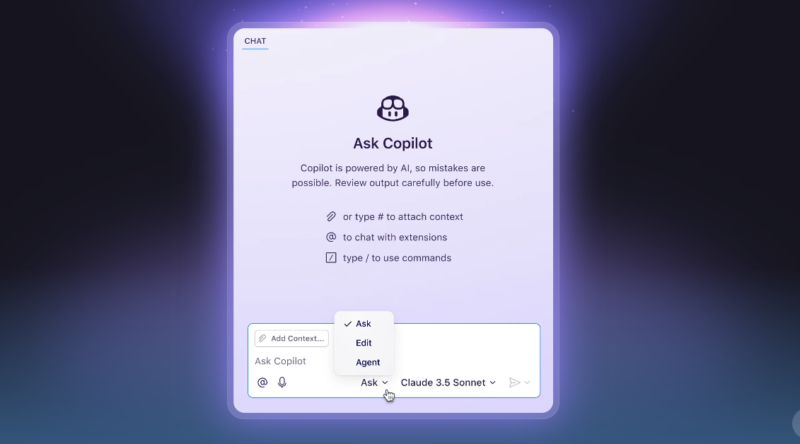
GitHub Copilot moved from premium request units (PRUs) to GitHub AI Credits on June 1, 2026. One AI Credit equals 0.01 US dollars, and usage is metered by tokens (input, output, and cached) at each model’s published rate. Base subscription prices are unchanged, and every plan includes a monthly AI Credit allowance that matches the seat price. Code completions and Next Edit suggestions remain free and do not draw from the credit pool.
For organizations, credits are pooled across the tenant, and admins gain budget controls at the enterprise, cost center, and user level. There is no longer an automatic fallback to a cheaper model: once credits are used up, work either consumes additional credits at the published rate or is capped by an admin budget.
Customer benefits at a glance
- Predictable annual budget for GitHub spend, even when monthly usage varies.
- Built-in savings of up to 15 percent compared with pay-as-you-go pricing.
- One prepaid commitment instead of managing many separate GitHub charges.
- Alignment with your existing Azure commitment and billing process.
- Flexibility to replenish or move back to pay-as-you-go if usage runs ahead.
How it compares with the Microsoft Agent Pre-Purchase Plan
If you are also looking at the Microsoft Agent Pre-Purchase Plan, the difference is scope. That plan is broader than GitHub and covers eligible usage across Microsoft Foundry, Copilot Studio, Fabric, and GitHub. Choose a GitHub Pre-Purchase Plan when GitHub is the platform you are planning around. Choose the Microsoft Agent Pre-Purchase Plan when your goal is agent development across the wider Microsoft platform.
Why GitHub Pre-Purchase Plans are relevant now
As AI-assisted development scales, more GitHub cost shifts from fixed per-seat pricing to usage-based billing, which makes annual budgets harder to set. A Pre-Purchase Plan converts that variability into a single, committed number, so finance teams gain predictability while developers keep working without hard caps. Because GitHub usage is billed through the Azure subscription linked to your GitHub organization, the plan fits the same commitment process you already use for Azure. For many organizations, that means lower risk, clearer cost ownership, and measurable savings on spend they were going to incur anyway.
What organizations should do now
- Review your GitHub usage across Copilot, Actions, and AI Credits over a recent month.
- Estimate your expected GitHub spend for the next 12 months to size the right tier.
- Decide which plan fits: the portfolio GitHub Pre-Purchase Plan or the dedicated GitHub AI Credits Pre-Purchase Plan.
- Confirm the Azure subscription linked to each GitHub organization, and choose a scope (for example Shared scope) that covers all of them.
- Check the prerequisites and roles: owner or reservation purchaser on the Azure subscription; the Reserved Instances policy enabled for an Enterprise Agreement (EA); or the matching Cloud Solution Provider (CSP) purchase path.
- Set admin budget controls so teams either flex above their pooled allowance or stay capped at it.

Ready to plan your GitHub commitment?
As a leading GitHub and Microsoft partner, SCHNEIDER IT MANAGEMENT helps you choose between the GitHub Pre-Purchase Plan and the GitHub AI Credits Pre-Purchase Plan, size the right tier, and align the commitment with your Azure agreement. Contact our GitHub licensing experts to review your estate before you commit.
Pricing note: All prices shown are non-binding and provided for information purposes only. Only a current, precise quote issued to the customer is binding.
Sources
For the announcement of the GitHub Pre-Purchase Plans, please visit: https://techcommunity.microsoft.com/blog/finopsblog/introducing-github-pre-purchase-plans-a-simpler-way-to-plan-your-github-spend/4528855.
For Microsoft’s documentation on the GitHub Pre-Purchase plan, please visit: https://learn.microsoft.com/en-us/azure/cost-management-billing/reservations/github-pre-purchase.
For the original GitHub Copilot usage-based billing announcement, please visit: https://github.blog/news-insights/company-news/github-copilot-is-moving-to-usage-based-billing/.
For useful software licensing information on GitHub products, please visit: https://www.schneider.im/software/github/